Sustainable, audited, measured where we can.
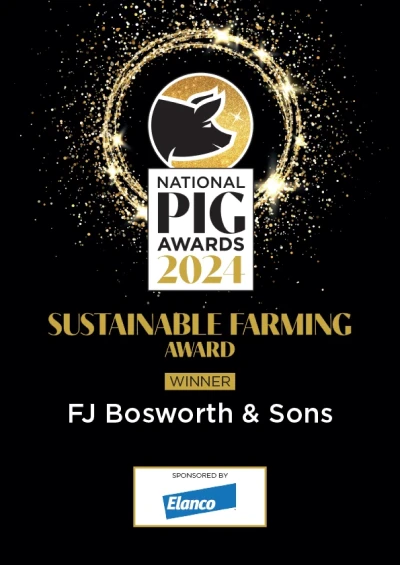
The National Pig Awards Sustainable Farming Award 2024 recognised the way we farm end to end. Below is the detail: solar generation, on-site milling, the circular nutrient flow, the carbon work in progress, and where we go from here.
Sustainability is a word that has been worked harder than most. We use it carefully. The work below is documented practice on this farm rather than aspirational positioning, and where something is still in progress (reducing soya includion for example), we say so. The Sustainable Farming Award in 2024 was given to the working model, not to a set of pledges, and the page reflects that.
What follows is organised by what we actually do. The solar energy generation and on-site milling, the circular nutrient flow between the arable and the pigs, the welfare and biosecurity work that connects to the broader story, and the measurement and ambition that will shape the next few years. The narrative version of the same model is on the Farm to Fork page; this page focuses on the environmental position specifically.
Power for the mill, generated here.
The grain that becomes our pig feed is milled on-site, using electricity generated from solar panels installed on the farm. The mill runs primarily during the working day when solar generation is highest, and the system is sized so that a meaningful share of the mill's annual electricity demand is met from the farm's own generation. The remainder comes from the grid as a baseload supplement.
The reason this matters environmentally is the link between energy and food. A bag of compounded feed delivered to a UK pig farm typically carries the embedded energy cost of transport, of the mill that produced it, and of the supply chain behind it. For the most part, we have shortened the chain to the length of a yard, and powered the relevant piece of it from the farm.
A mill on the farm, not a lorry from elsewhere.
We mill our own grain on the farm, in our own facility, rather than selling the grain and buying in compounded feed. The mill comes with a continuous capital and operational commitment. Operationally, milling on-site means the feed is fresher, the feed composition is precisely what we have decided rather than what a compounder has formulated, and the transport carbon of the home-grown cereals we use is effectively zero. The trade-offs (more workload, more responsibility on us to get the recipe right) are accepted because the upsides outweigh them.
Manure back to the land, not to landfill.
Pig manure is collected, stored, and applied back to the arable land using our contracting team's slurry equipment, precision application control. The nutrients that left the field as a crop and then entered the pig as feed are returned to the next field as fertiliser. The cycle is genuine, not metaphorical: the same nitrogen and phosphorus moves through it.
The environmental significance of this is in what it avoids. A conventional pig farm without arable to apply manure to has to manage the manure as a waste stream; an arable farm without a livestock enterprise has to bring in bagged synthetic fertiliser. We do less of both. Bagged fertiliser is still used where the crop needs it (and the contracting team applies it for other farmers across Essex at working widths up to 36m), but the contribution from the pigs reduces the synthetic fertiliser load on our own land.
Sustainability includes the animals.
Sustainable farming, as the term is now used by serious audit schemes and award organisers, includes the welfare of the animals at the heart of the operation. The herd is housed in modern indoor facilities, Red Tractor assured, with quarterly vet visits and strict biosecurity. We have made the indoor housing choice as a deliberate welfare position, not as a default. Done well, it gives the animals more consistent conditions and lower disease exposure than outdoor systems typically can in this climate.
The full welfare picture, including housing detail, vet relationship, biosecurity protocols, and the case for indoor housing specifically, is on the Our Pigs page.
The award that validated the model.
The National Pig Awards Sustainable Farming Award in 2024 was given to the operational model described above. It was not a recognition of a single project or a single initiative; it was a recognition of how the farm runs end to end.
- Award
- Sustainable Farming Award
- Year
- 2024
- Awarded by
- National Pig Awards
Measuring what we can, honestly.
From directional confidence to numbers we can stand behind and improve against.
We are part way through our five year commitment as one of the 170 farms chosen to be a pilot for AHDB's Environmental Baselining Pilot. We signed this agreement towards the end of 2024 with the aim being to collect and compare data that can help us make informed decisions to reduce environmental impact.
We expect the pilot to confirm the broad shape of the sustainability picture: lower transport-related emissions because of the short feed and abattoir distances, lower fertiliser-related emissions because of the manure substitution, lower energy-related emissions because of the solar generation. We also expect it to identify areas where the picture is less favourable than we might assume, which is one of the reasons for doing it. The point of measuring honestly is to find what to improve.
- Status
- Pilot in progress
- Scope
- 1, 2 and material 3
- Audit partner
- To be named
This page will be updated when the pilot completes and figures can be published with confidence.
The ambition and the next few years.
The longer-term direction is to keep tightening the loop: more renewable generation on-farm, more closed nutrient flow, better measurement and reporting. We expect new assurance schemes, customer expectations, and regulatory frameworks to keep shifting the picture, and we want to be ahead of them rather than catching up. None of this is dramatic; it is a continuation of work that has been going on for a long time, with a sharper edge on the measurement side. We will update this page as things change.
Want to discuss the sustainability work?
Trade buyers running sustainability checks, journalists writing on sustainable agriculture, award organisers, and procurement leads with environmental commitments of their own are all welcome to get in touch. We are happy to talk specifics, and to share what we have so far.